Monday, February 16, 2004 Last modifiedSaturday, December 20, 2003 11:14 PM PST
Janet Throop/Venture contributor
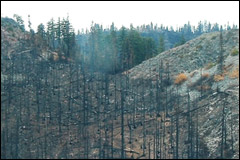
Last summer's B & B Complex fire scarred thousands of acres, but made for great skiing.
Hot skiing
Santiam Pass fires leave great cross country environs
By Allen Throop Venture contributor
Shortly
after Santiam Pass was reopened after the forest fire of last summer, a
friend drove over U.S. Highway 20 and told me about the miles of
devastated forest she saw.
A
few weeks later, with smoke and helicopters still in the air, I
followed her route. The charred spires of a former green forest were
not a pretty sight. I tried to suppress a thought but it kept coming
back and back.
Now, as snow accumulates on the pass, I can no
longer hide my feelings: Cross-country skiing the trails of the burned
area will be great!
When my family first started cross-country
skiing at Santiam Pass in the early 1980s, we would often go to Ray
Benson Sno Park and ski to the south. Between the parking lot and Big
Lake was a large, open, gently rolling area covered with small
lodgepole pines that were buried for the winter after a few snowstorms.
We
could ski in any direction, and with clear weather we had constant
views of extinct volcanoes to keep us oriented: Hayrick Butte to the
west, Mount Washington to the south and Three Fingered Jack to the
north.
In time, I recognized that the open area was the site of
a forest fire, and during years of skiing, the boundaries of the 1967
Big Lake Airstrip fire became clear to me.
From Big Lake, to
Sand Mountain, to the top of the ski lifts at Hoodoo, the burned land
was covered with manzanita, ceanothus, young lodgepole pine and other
vegetation typical of burn scars and clear-cuts in the Cascade Range.
From any high spot, the landscape of gray spires accented with charcoal patches was easy to pick out.
Each year, we became more familiar with the land.
One
winter, I thought the snow was shallower than usual because the young
trees were obviously sticking out more than they had the previous year.
I was wrong. The new lodgepole pines were getting taller.
As the years passed and the growth rate quickened, skiing off the trail in the burn scar grew ever more difficult.
As our skiing ability improved, we turned adventurous and left the trails behind.
Some
days we would ski north toward Three Fingered Jack, an area that had
not been burned. The mountain slope was steep but the scenery changed
little from year-to-year.
Immediately upon leaving Santiam Sno Park, we would be in a wonderland of deep snow, green needles, and brown bark.
Unless
we climbed high onto the rocky shoulders of Three Fingered Jack, our
world was restricted to the snow beneath us and the trees around and
above us.
On other days, we would ski between Hayrick Butte and
the Hoodoo ski area and head for Sand Mountain, avoiding the
snowmobiles by using the old Santiam Wagon Road and working our way
through the young trees. The view from the top of Sand Mountain, even
before the fire lookout was restored, made the trip out and back
worthwhile.
If we had left a second car at Potato Hill or Little
Nash Sno Park, we would eat lunch at The Rock, a place identified on no
map and known to few others. On a sunny day, the rocks radiated warmth
as we enjoyed the view, and when the wind came from the west, large
trees provided shelter.
Telemark skiing down a steep clear-cut slope below The Rock was a highlight of most trips.
Last
year, when my favorite wife and I made a final trip around the South
Loop Trail at Ray Benson Sno Park, we had little choice but to stay on
the trail in much of the burned area. Only through constant maintenance
has the trail been kept free of vegetation.
Despite the setback
of the 1960s fire, sizable trees once more dominate the landscape.
Views of Mount Washington are now infrequent, although still available
in spots such as near Brandenburg shelter, where the trees have not
re-grown.
Likewise, telemarking through the clear-cut below The
Rock is no longer fun. The skirts formed by the branches of the trees
planted after the loggers left are now touching.
Perhaps in 50
years, when the conifers are sizable, a good skier will yodel with
delight while carving beautiful turns in fresh snow with the tree
canopy high above.
The B & B Complex fire of 2003 unquestionably made drastic changes as it consumed the vegetation near Santiam Pass.
The
fire covered approximately 92,000 acres north and south of Highway 20
last summer, over 10 times the size of the 1967 fire. Most, but not
all, of the fire was north of the highway.
Parts of the North
Loop Trail were burned. The North Blowout Shelter is gone. Many islands
of unburned or partially burned land remain within the fire's perimeter.
If I were skiing at Santiam Pass this winter, I would explore the drastically changed landscape along North Loop Trail.
The
Forest Service has reestablished the blue route markers and has removed
the burned trees that could be hazardous to trail users. The contrast
between the green unburned areas and the black burned area should be
dramatic, and on a clear day, the newly opened vistas should be
spectacular.
Exploring the burn from the official trails might be enough for this winter.
Life and death in the forest continue.
Snow
is falling and building up on branches, dead and alive. The wind will
blow. The sound of trees falling and branches breaking will echo
through the burned forest, regardless of the questions asked by
philosophers.
Insects and fungus are already starting to eat
away at all the newly dead wood. Black-backed woodpeckers are licking
their long pointed bills knowing that each dead tree can be a new
restaurant for them.
In a few years, the smell of ceanothus and
the distinctive sight of manzanita bark will increase dramatically in
the burned area.
Cross-country skiing has long been popular at
Santiam Pass, and the fires of last summer should not deter visitors
from the trails this winter.
In a few years, the dead branches
now hanging in the trees will be on the ground, the tottering trees
will have toppled over, and grand views from the slopes of Three
Fingered Jack will reward those adventurous enough to make the trip.