New Horizons Arrokoth Flyby, December 2018 - January 2019
NASA's New Horizons misson launched in 2006,
and flew past Jupiter and Pluto before finally reaching the Kuiper belt object
Arrokoth (aka 2014 MU69,
aka (486958) Arrokoth, and briefly known as Ultima Thule*) on January 1, 2019. I
have been a member of the science team since around the time of launch.
Here
are some photos from the flyby of Arrokoth, taken during the 10 days that the
science team re-assembled at APL for the flyby. Arrokoth is tiny compared with
Pluto (diameter of 20 km vs. 2400 km), so the flyby was comparably compressed
in time. The target was only resolvable (i.e., more than a single pixel) about
24 hours before the flyby, compared with several months of resolved
observations when we were on approach to Pluto in 2014.
APL is usually off-limits to photos. I am really grateful to the support of
the mission and APL in arranging for me and others on the team to take photos
during the encounter. Thanks in particular to Carl Engelbrecht, Lisa Turner,
Mike Buckley, and Alan Stern.
* The official IAU name Arrokoth was introduced
11 months after flyby, in November 2019. We called it Ultima Thule at the
time of flyby, which was always intended to be a temporary, informal name. In
the captions, I've changed most of the names to Arrokoth, though I've kept some
references to MU69 and Ultima Thule in the quotes.
All these pictures (and thousands more!) as a timelapse:
My other New Horizons galleries:
New Horizons Arrokoth Flyby, January 2019 (this gallery)
It's December 27, and the science team has assembled for the Arrokoth flyby! Although it's been three years since the Pluto flyby, most of the same team has been working on the planning for this one, which we started on just after Pluto. I was on the Hazard Team searching for dust at Arrokoth (*) that could be in the way of the spacecraft, and we'd been here since Thanksgiving, except for a week off around Christmas. The rest of the team assembled in-person at "K-3d" -- i.e., three days before the flyby in the Kuiper belt.
(*) The official IAU name Arrokoth was introduced a year after the flyby, in 2019. We called it Ultima Thule at the time of flyby, which was always intended to be a temporary, informal name. In these slides, I use all three names interchangably.
New Horizons Project Scientist Hal Weaver kicks off our 41st Science Team Meeting.
We are 3.6 days out from Arrokoth, and things are going great!
You can see here the fundamental difference between the Pluto flyby and Arrokoth. Here we're at K-3 days, and the target is still a tiny dot. Here's we're summing 9 high-resolution frames, and Arrokoth is completely undistinguished from the background stars. (Of course, we know which pixel it is because we see it move.) It's one pixel, and it's faint.
At this time during the Pluto encounter ('P-3 days'), Pluto was already more than 100 pixels across (10,000x larger by area!), and we were practically counting craters and doing geology on it. Arrokoth is tiny, and dark, and further out, and moving more slowly, and we don't know its position well -- a far harder target to get to than Pluto.
APL Project Manager Helene Winters, with Project Scientist Hal Weaver.
Project Manager Helene Winters gives the status overview. From a technical standpoint, the mission is doing extremely well.
The only major issue that has come up is on the public affairs side of things: due to the 2018 US government shutdown, the NASA press office cannot be involved with our encounter. No press releases, no web sites, no social media support, and no NASA TV.
In the end we were fortunately able to arrange things with them so that the world could see the critical moments of the flyby, live on NASA TV -- even during the shutdown. APL handled the rest of the media themselves, filling in for NASA to cover press, social media, web production, and on and on
Although New Horizons is a NASA-funded mission, we were quite fortunate that given the shutdown, New Horizons is not a NASA-operated mission, which gave us the autonomy to continue activities.
APL Deputy Project Manager Carl Engelbrecht chats with Helene Winters.
In the center, that's the Composition team ('COMP'), who will be looking at the spectral and multi-wavelength data to study the composition of Arrokoth. At front are Jason Cook, Carly Howett, Will Grundy, Bernard Schmidt, Alissa Earle, and Rick Binzel.
Kelsi Singer talks about impact craters on Pluto!
Kelsi knows everything about cratering in the outer solar system. No wonder she won the DPS's Urey Prize a a few months later!
Oh look! If you examine that image closely, you can see dozens and dozens of moons around Arrokoth. My taking this shot made Marc Buie (far right) very uncomfortable, since he didn't want any fake images to leak out ("So, we hear reports that MU69 is surrounded by more than 20 moons?!").
So here is the disclaimer: These are fake moons! John Spencer put them into the images, as an exercise so we could search for them and figure out exactly how sensitive our images and search algorithms were.
If anyone wants to publish this 'image' in Icarus, you've been warned!
Tod's computer is showing Arrokoth's current PSF = Point Spread Function, as measured by our high-resolution LORRI camera. What you can see here is that there is no evidence for any non-stellar PSF. That is, the spatial distribution of light from Arrokoth (left) is indistinguishable from that of a star (middle). Far right is the difference, which is flat. This is insane: it is showing us that even with three days left to go, Arrokoth is so tiny, and we are still so far away, that it is completely unresolved and nothing more than a point of light. There's never been a flyby like this in the history of the space program -- much less one at 44 AU.
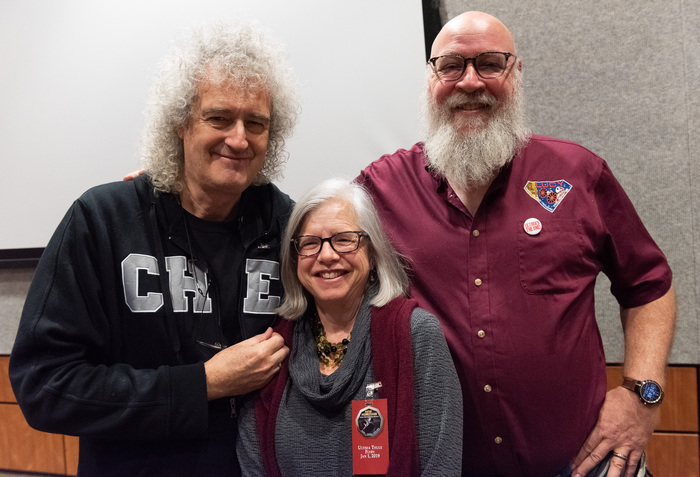
Oh look! Lyrics from Bohemian Rhapsody... we love Brian May and are looking forward to his arrival.
Note the time and distance to the target, updated daily: K-4d (rounded up), and 4.5 million km. On the left are the list of 'Hazard' sequences that were were analyzing during November-December: 110 of 110 in the HAZ0 sequence successfully downlinked, etc.
Cristina Dalle Ore and Francesca Scipioni talk spectroscopy.
Mark Showalter is giving an overview of the Hazard team's final results. Summary: we spent a month looking, but we found no rings, no dust, no moons, and thus no reason to divert the spacecraft to a safer, more distant flyby.
"Oh come on Stuart -- don't put a logo in that photo," says Veronica, as they both sit in front of their Apple laptops.
OK, here's Carl Engelbrecht and my friend Srinivas Laxman.
I am living in DC now, but I spent the last three years before the flyby living in Bombay, India. Srinivas is a journalist for the Times of India. He's a space nut, and a huge fan of anything that goes into space, from ISRO or NASA or any other agency. I knew him well in India, and he came to dozens of talks that I gave. So I was really excited that he was able to come out to the Ultima Thule flyby, and cover it for the Indian press.
Srinivas: "All is good Henry, and I am so excited to finally be here. But I don't understand, one thing, Henry. Let me ask you this. I am registered with the media office. But... when will I get my badge? In India, that is the first thing they will do -- send you your media badge, many months ahead of time."
Me: "Oh, it's fine. We'll just walk over and get it."
Srinivas: "But we can't just walk over! There must be, you know, a gate. And then security. And another gate. And more gates, and checks. I think, certainly, I must set aside at least four hours in the morning to get through the security process, no? I must go there today, two days early."
For what it's worth, APL is a very secure area, but Carl Engelbrecht and APL's media office did a great job making sure that journalists from around the world had access to all of the same briefings and tours to cover the story.
And, it was especially cool that Carl grew up and lived in South India for the first 17 years of his life. "I went back there a few years ago. I could still speak Tamil, and the families that we knew, we still remembered each other so well." The Indian press got word of Carl's involvement with New Horizons, and did even wrote up a neat article on him.
Carl Engelbrecht and Srinivas Laxman, with New Horizons above them in the APL lobby.
APL's Helene Winters took over as New Horizons Project Manager from Glen Fountain. Glen kept threatening to retire throughout NH's cruise, but he count never really pull himself away until after Pluto. "Glen Fountain is retired techncially. But he still comes over quite a bit..." -- we saw him a lot during the Arrokoth flyby.
Meanwhile, Helene tells me about her trips to India, where she was involved in the Mini-RF instrument. It's a US-built instrument which flew on India's Chandrayaan-1 spacecraft to the moon, and Helene took many many trips to Bangalore to support its development and integration.
Spectroscopist Jason Cook! Jason has been a long-time SwRI-ite, recently relocated to the the high-altitude Pinhead Institute, in Telluride, Colorado.
Glen Fountain, Hal Weaver, Paul Starkis, and Leslie Young. I recognize that classic hat of Hal's -- it was a freebie given out at New Horizons launch in 2006!
Leslie: "OK, get this. I talked with the bartender here -- her name is Lauren. And I asked her, hey, can you make up a drink for us. Our spacecraft is flying to somewhere very cold. We think it's covered with ice. Maybe some cryo-volcanism. N2, CO2. Likelihood of organic molecules. Maybe a reddish tinge. Now, what kind of a drink can you make that matches that? We're going to call it an Ultima Thule!"
Leslie's recipe for the Ultima Thule, courtesy of bartender Lauren at Kloby's BBQ in Laurel, MD.
Leslie Young and Paul Starkis, with three Ultima Thules.
NASA Chief Scientist Jim Green was out of work due to the government shutdown. But he showed up as a private citizen to see what we were doing. Here's Jim with Tom Krimigis, emeritus head of APL's space department.
Jim Green rallies us!
Tom Krimigis.
Tom Krimigis.
Simon Porter.
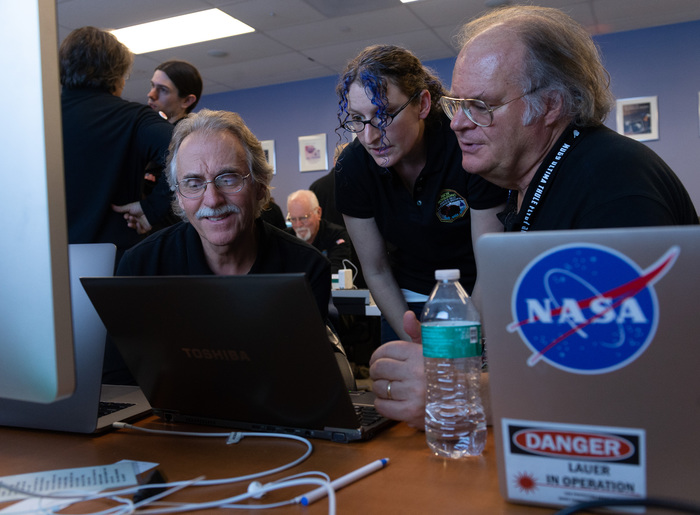
John Spencer and Tod Lauer have discovered something awesome...
A special music interlude: Tim Blaise of Acapella Science, in PLUTO MARS: Outbound Probe. Here we all watched the excellent video Tim showed up in person a few days later.
Time for another artistic interlude: Alan Stern gives us the heads-up on Brian May's latest single, New Horizons. . It's set to be released a few minutes after midnight on January 1, 2019, from the Kosiakoff Center at APL. But we get a sneak peak!
And we watch the opening sequences of Brian May's New Horizons single. It has lots of great animation from STK plots that we've seen during sequence planning, that has now made it into a music video!
John Spencer discusses the limits on binarity. That is -- we are at December 29, two days before encounter, and we still have no idea if our target is a single, or a binary. Could be anything! You can see the posible limits on the screen (e.g., Arrokoth could be two equally bright objects separated by 18 km, or a bright and a dark one separated by 42 km).
Here's another way to look for binaries, or for any shape other than a single, unresolved small body. Tod Lauer has extracted the Point Spread Function (PSF) of Arrokoth, and of a typical star. Stars are always point-sources since they're so far away. Anything resolvable would be larger than a point. And at this point, December 29, there is no measureable difference between Arrokoth (labeled MU69 here) and a star. They're both too tiny to see even the slightest detail.
And check it out. Here is our most beautiful image so far of Arrokoth. It's just a bright point, in the middle of a sea of noise.
The black-and-white speckles at the top are the remnants of stars which have been partly subtracted off -- this is a dense star field, and without subtracting the stars, it would be difficult to see Arrokoth at all.
Another awesome plot on the parameter space balancing the compatible sizes of a contact binary vs. a separated companion.
OK, time for a special media event! There were 50 or so media at the Arrokoth flyby. They were mostly limited to be in the Kosiakoff Center (APL's theater and events / press building) for their activities. But, there was an hour-long session where they were given the chance to come into APL's 'Building 200,' where the science team did their work. We were told to "look like you're doing science!"
Rick Binzel and Silvia Protopapa engage excitedly, as Cathy Olkin bemusedly looks on.
In reality, most of our real science happened in the Geology room upstairs, but we did have twice-daily meetings in this room where the whole team came together.
Hal Weaver holds court with the journalists. Everyone loves Hal.
Mike Summers, Heather Elliott, and Randy Gladstone passionately discuss the page margins for their upcoming LPSC abstract.
Andy Chaikin chats with Tod Lauer. Never mind that microphone over their head!
Mark Showalter gets interviewed!
Doug Hamilton with Srinivas Laxman.
Alex Parker does an interview over the fence.
Cristina Dalle-Ore and Francesca Scipioni talk about color clustering, in the light of the TV crews.
Cathy Olkin: "Oh, look how busy we are! Honestly, that's how I do spend most of my time these days, is in the calendar program."
Alissa Earle shares the details of her calendar.
Geoff Haines-Stiles and Art Howard in action. Taken earlier -- they were working with the team throughout, and not just here for the flyby.
The whiteboard list of KNOWN DEVIATIONS FROM REALITY refers to one of our operational tests, where we used 'fake data' to simulate the encounter pipelines.
Media are gone now, and Alan Stern and Hal Weaver have some awards to give out. The Golden Jersey goes to Mark Showalter, for commanding the Hazard team.
And the Blue Jersey to John Spencer, for being in charge of the MU69 Encounter Planning team.
John Spencer and Mark Showalter get jerseys-of-appreciation for their work keeping our spacecraft long-living and prosperous!
Tod Lauer is about to show "The 2014 MU69 Donut Test." This title slide itself was tweeted out at one point before it should have been, leading media to inquire about our donuts, and whether we'd resolved the target yet.
And the result of the donut test is... check out that donut! Look in the third panel, and you can see a very faint ring, showing the difference in PSF from a star (center) and Arrokoth (left). That means that we're finally resolving Arrokoth. It's no longer a point source, but is just barely resolved... perhaps only 1.1 pixels across now, but that counts!
Shared with permission. No, you cannot drive the spacecraft with any of the commands on his screen.
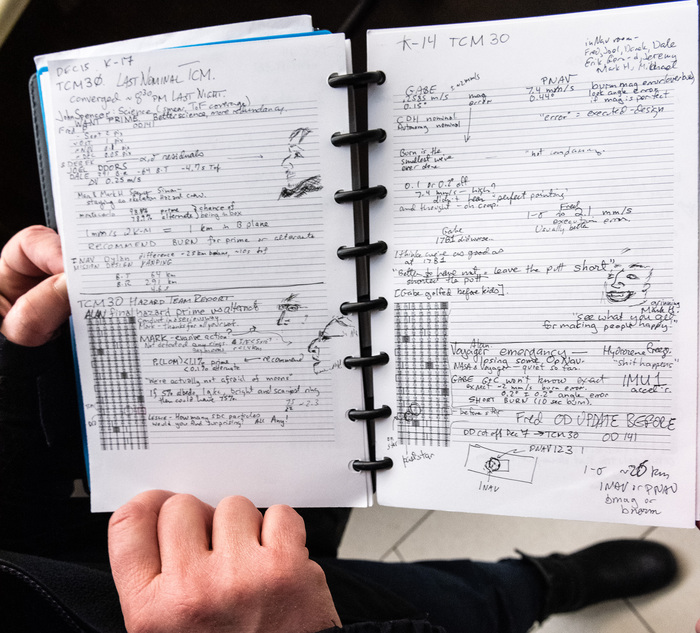
So much content in Leslie Young's notes at K-3 days. The big things: "Derek: Could start seeing PSF broadening" -- i.e., we're starting to get close enough that MU69 is no longer a point. And of course: "3:48 PM Alan: CONFIRMED -- ENCOUNTER MODE" -- i.e., New Horizons is on course to fly past Arrokoth and observe it, and the encounter is completely out of our hands from here on out.
I love Leslie Young's sketches and quotes!
This one is from earlier in the month, but here it is. The real meat here is halfway down the left side of this entry from December 15, at the end of the hazard campaign: "Pr(LOM) < 1.1% prime recommend, < 0.1% alternate" -- i.e., we're flying the prime mission, since we've found no rings or any evidence for significant danger. Pr(LOM) = Probability of Loss of Mission.
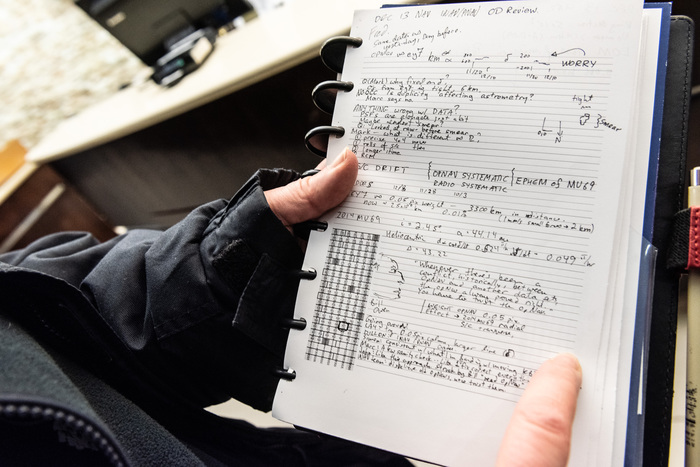
And from another one of Leslie Young's book of sketches and notes, Bill Owen on Optical Navigation: "Whenever there's been a conflict, historically, between OpNav and another data set, the OpNav always proved right. You have to trust the OpNav."
Bernard Schmitt in the APL lobby.
Nova producer Terri Randall (in the plaid with scarf) sets up with her crew for filming in the APL lobby.
Anne Verbiscer (center) talks with Nova producer Terri Randall (in plaid). Nova did a really incredible job of keeping up with the latest development. They put together an hour-long show about the Arrokoth flyby, using footage covering three years of planning, and the latest results up to the day before airing. It's a terrific program.
JPL navigator Bil Owen drops by. New Horizons has two navigation teams, each working independently and comparing their results in the end.
Seem like overkill? Such a setup almost certainly would have saved the Mars Climate Orbiter from crashing into the planet due to a units-conversion error.
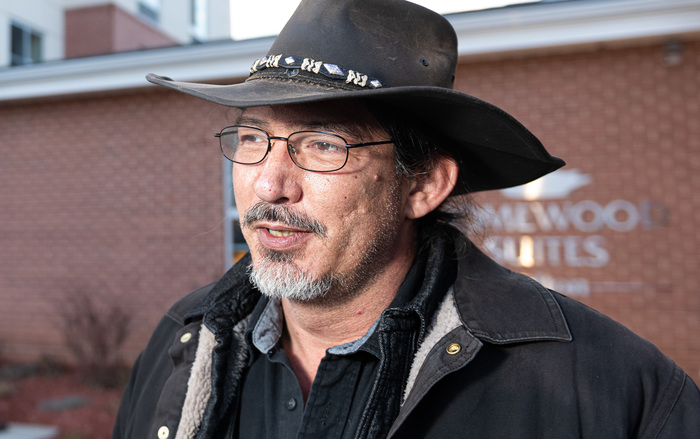
Cindy Conrad's brother Larry has come out from western Kansas for the flyby. Much of the team is staying at the Homewood Suites right adjacent to APL. The hotel was promised to be open for the Pluto flyby, but in reality was still an empty shell. It finally did open a year late, and now we are all saved from having to drive to Columbia.
Heather Elliott is dreaming about plasmas on Arrokoth.
All of the press events are being held at APL's Kosiakoff Center, which is the building in the middle. The auditorium is off to the right. I headed over to the K-Center to take photos at one of the press briefings.
At the pre-flyby briefing, APL's Space Exploration head, Mike Ryschkewitsch ('Miker') give an overview of the New Horizons project.
Ooo -- check out that shirt he's wearing. It's not for New Horizons, but actually for Dragonfly. Dragonfly is a nuclear-powered drone that APL was proposing to fly to Saturn's moon Titan. Six months after the Arrokoth flyby, NASA announced that APL was selected to build Dragonfly and head to Titan. So cool. With that, APL will have built two of NASA's four 'New Frontiers' missions: New Horizons, and Dragonfly.
Jason Kalirai, APL's head of Civil Space, talks about APL's broad space program. Jason joined APL from STScI a few months before the flyby.
Mike Ryschkewitsch and Jason Kalirai.
Reporters at the back of the room for the media briefing.
Press from NHK (Japan) in the press conference.
Marc Buie (SwRI) talks about the discovery of Arrokoth, and then occultations that made the flyby possible.
Panorama shot of the press room. There were about 90 registered press at the flyby.
Marc Buie in the press conference.
Q: "So what are you up to now? Is there anything left that you can actually do, or do you just wait?"
A: "I just did my last report. The Nav effort here is effectively finished. From here on out, it's party time."
That's Mission Operations Manager Alice Bowman, answering questions about the flyby, mission operations, words of wisdom, and the phone-home message.
Q: "How is the team holding up? Are you sleeping at the lab yet?"
A: "Yes we are, in fact! We have mattresses, sleeping bags, and one gentleman even brought in a tent. I slept a bit last night and then came in at 3am from home!"
Leonard David of space.com and other sites. [Update: This is not Leonard David. Please tell me if you know who it is.]
Kenneth Chang, science writer for the New York Times.
Astronomer and writer Chris Lintott (BBC Sky at Night). Look closely at that heart: it's not just a rainbow, but a super-high-resolution spectrum of an exoplanet host star, with visible absorption bands -- the sort of spectrum used by radial velocity surveys to detect exoplanets.
Hey -- it's science journalist Carolyn Collins Peterson, who I haven't seen much of since we took a geology field trip to MarsHawaii during grad school. She wrote her thesis about press coverage of the Hubble Space Telescope spherical aberration issue. At her right is Mark Peterson (the other half of Loch Ness Productions), with Kenneth Chang behind.
Will Grundy and Randy Gladstone tag-team the press conference from the science side..
Will Grundy: "Anyhow, that's what I'm interested in: the composition and history of this body. At least I'm going to get data. Now I'll let Randy talk. Haha!"
Randy Gladstone speaks up for the ultraviolet atmospheric observations, which are admittedly a long-shot, because the Sun is faint, and Arrokoth's gravity can't retain much of an atmosphere.
Randy: "You know, we really don't expect to see much here. We're doing our due diligence. But it would be real surprising if we saw a whopping big atmosphere here, or really anything at all."
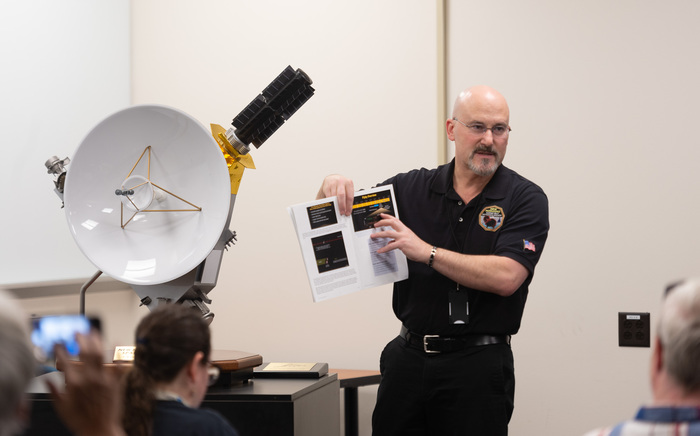
Project Scientist Hal Weaver uses the closest object at hand -- his wallet! -- to demonstrate the rotational parameters of Arrokoth as it rotates about its shortest axis.
Unbeknownst to him, Arrokoth would actually turn out to be very flattened as well (perhaps like his wallet after flashing it around at too many press conferences).
Hal Weaver at the press conference.
Deputy Project Scientist Cathy Olkin talks about the spacecraft's observation plans.
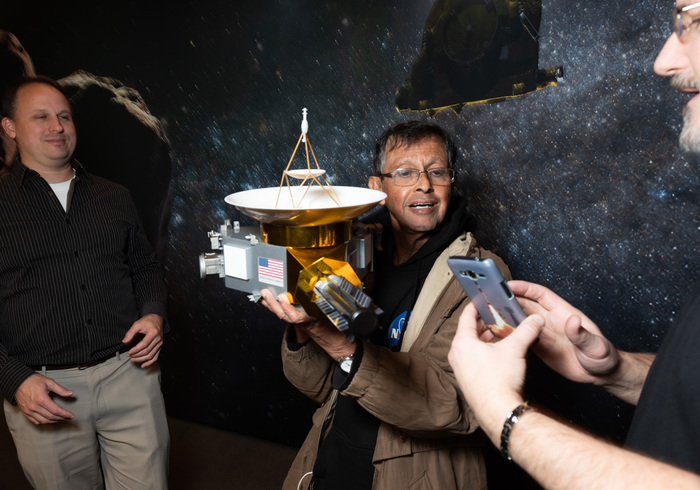
Deputy Project Scientist Cathy Olkin shows some rotations using the 1/4-scale mockup.
Cathy Olkin in the press room.
Jeff Moore, head of the Geology and Geophysics team, answers your questions!
Mission Systems Engineer Chris Hersman talks about the spacecraft.
Mission Systems Engineer Chris Hersman is a great speaker and I love watching him talk. Plus, his job is to know everything about the spacecraft: he is effectively the 'lead engineer' on the project, accompanied by a team of others from APL and elsewhere.
Chris Hersman.
And finally, last speaker of the day: it's Alan Stern!
Alan: "It's remarkable that we know basically nothing about this thing we call Ultima Thule. In 48 hours we will know a ton! But right now, I can't tell you more than 5 facts about it. I can't tell you its size, or its reflectivity. And I can't even tell you its rotation rate! We should have known that 10 weeks ago!"
Alan stern at the podium giving a press briefing, with APL's Mike Buckley at the right, and a lot of journalists.
Alan Stern.
Questions for Alan!
The NH mission went to an effort to include many social media writers including several kids -- one shown here at the center.
___ name?
Science writer Ken Chang (New York Times) chats with Will Grundy about the flyby.
Science writer Nola Taylor Redd talks with Randy Gladstone and Heather Elliott after the press conference.
At work: Mike Buckley, the APL press and media head, tries to herd scientists.
One of the younger media covering the press conference. He writes for his local newspaper. (name??)
Bobby Russell runs Quest for Stars, an outreach operation which works with a ton of schools to fly balloons and rockets. Really cool!
Back in the main GGI room, oh look! There's Oliver and Casey... but much more importantly, check out that screen behind them. We're at T-26 hours, and we are beyond the donut stage now on that PSF! That's Arrokoth at left, a stellar PSF at center, and the residuals (i.e., Arrokoth - PSF) on the right. You can clearly tell that our target is looking non-stellar. It's about time!!
We have an image!! It's resolved, and we can see Arrokoth for real now! At left is the actual, full-resolution LORRI frame. At right is the interpolated, over-sampled version (which is not incorrect, but does give a smoother impression than perhaps justified). This sequence was internally known as our ROTCOVER_364B observation, at 11 km/pixel. Arrokoth is about 30 km tip-to-tip, so it is clearly resolved.
I came into the Geology room just as the ROTCOVER_364B observations came down and Tod started processing them. Tod became (by a few seconds) the first to see Arrokoth's resolved shape. I could tell he was 'in the zone,' so I hit record. He's drumming along to Steely Dan's "FM," while running his FORTRAN-based imaging code which has needed only minimal upgrades since first developed in on a PDP-11/70.
Tod Lauer: "You know, I never in a million years thought that my career would take me to that place of 'on-demand image processing.' I was really happy to sit in my office and take my time to optimize my algorithms and really develop a great framework for image processing. And here we were -- there's like 30 of us in the room, everyone's shouting, and -- bam, the images are down, and it's a race to process them. I could never do that before -- I could never zone out in the chaos surrounding me like that. I had to really train myself to listen to music to tune it all out."
The flyby is about 8 hours away. Let's go to the main Geology work room upstairs, and watch a press conference! That's Alan Stern giving a media briefing from the APL Kosiakoff Center. Note that flag on the wall too: it's from the Arrokoth occultation campaign to the city of Comodoro Rivadavia in Argentina in 2018, where Arrokoth's shape was first nailed down.
Casey Lisse, Mike Summers, and Mihaly Horanyi look at a 3D-printed asteroid Itokawa model. Behind them, Andy Chaikin has put together a nice graphic showing Arrokoth's blobby self, to scale with other small bodies in the solar system.
Olivier White, Stuart Robbins, Jeff Moore, Veronica Bray, Ted Stryk (occulted), and Bonnie Buratti.
We're at T-6 hours, and we have a new image, again! We're starting to get really resolved now. [NB: Is this different than ROTCOVER_364B?]
Rick Binzel: "I've got it downloading straight to my watch!"
___, Derek Nelson (KinetX navigation), and Gabe Rogers (lead Guidance & Control engineer) chat about navigation.
Kirby Runyon in his office at APL.
The calendar, in the Composition Team ('COMP') room! On the left are the times of the plenary sessions (i.e., with all of the science team together). We have these twice a day, downstairs in the big room. On the right are the COMP team meetings, in this small conference room ('The Fishbowl').
Mihaly Horanyi, PI of the SDC = Student Dust Collector. Note all that Pluto-system memorbilia behind him, as well as the handy list of NAIF SPICE ID codes for New Horizons (-98) and Arrokoth (2486958).
Mihaly: "You might not know it, but I am right now half-owner of a coffee shop in Winter Park. My son Andras talked me into it, and he knows the coffee business very well, or at least he says he does. And what do I know... nothing at all I think! Actually, it's very good -- it is all his effort really. So you should come visit it."
On the evening of the flyby, it's a cold and wet scene at APL.
The APL Space Department building -- our home for the flyby. We're at T-2.5 hours for the flyby, so I head on over from Building 200, across campus to the Kosiakoff Center. It'a a wet night.
Heading across the street to the K-Center.
The APL 'Building 1' auditorium and main entrance.
Once I get over to the K-Center, I run into Ka Chu Yu (who I spent a lot of time with during our time in grad school together) and his spouse, artist Kim Colgrove.
"Hey! We're doing a lot of interviews here for our show. Can we interview you? How about right here?"
Also in the media room: I run into Christian Ready (left), who runs the LaunchPad Astronomy podcast and YouTube channel. Bill Higgins (right) from Fermilab is joining him on this show. They were broadcasting live from the K-Center for many many hours, interviewing a lot of guests and doing a great commentary on the mission and the encounter. And yes, I did an interview with them too!
Here's Kevin 'Sody' Elias. His connection to the mission? He grew up as a next-door neighbor to the family of Pluto discoverer Clyde Tombaugh, in Streator, Illinois!
Helen Hart takes a break from the Mission Operations Center at APL. Helen was the Flyby Load Lead for all of the Arrokoth flyby, meaning that she has spent the last two years of her life overseeing, validating, and testing all of the sequences we've uploaded to the spacecraft.
Casey Lisse (in the back), with his entourage.
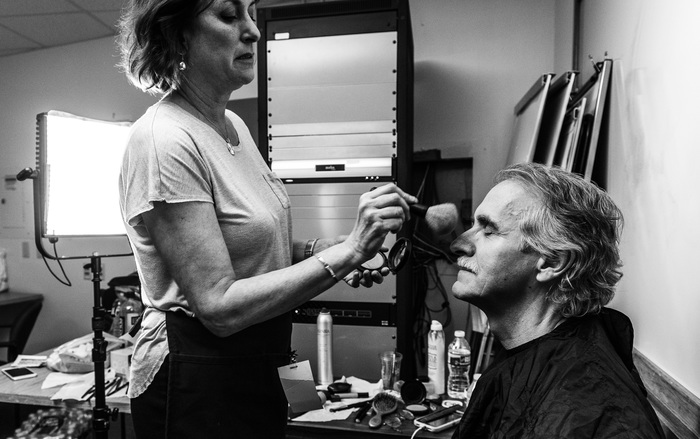
John Spencer gets decorated up for TV!
John Spencer gets decorated up for TV!
Aaron Resnick with his family. He and I were two of the 50-odd people who observed for the occultation campaign in South Africa in 2017. Many of those people have remained involved in the mission -- observing more occultations, and coming to the Arrokoth flyby. The participation of 150+ ground-based observers on the occultation campaigns really broadened the reach of the mission.
Aaron Resnick: "Oh, and check this out! You remember that photo you took of the four of us at the MU69 occultation in in South Africa? I got it put on the front of my credit card! That is the most awesome photo ever and I love it!"
Aaron and I were paired up to drive a pickup 600 miles across the South African karoo to outrun an oncoming storm. We ended up observing the occultation, searching for a three-second flash using a telecope set up in the middle of an ostrich field.
This shot, which I took as we were waiting for the event, ended up being the NASA.gov homepage image for a week or two.
OK, my family has shown up now, after a quick drive up from DC. Here, Astro is using the VR goggles to walk through a model of the spacecraft.
Finn walks through the VR New Horizons as well.
Finn: "Hey H! Is that guy back there Brian May? Take a photo of me, with Brian May in the background!! Piper is going to be so jealous!!"
Piper: "Oh yay, some food!"
Me: "Piper, that brownie looks just like MU69 the way you have bitten it. It's bi-lobate! Here, hold it up for a picture!"
Piper: "Dear god..."
Piper: "Here, I can give you my annoyed teenager look!! Would that make a better photo for you? Now can I see your photo? Oh, that looks awesome -- I am so good at faking the annoyed teenager look!!"
It's the newlyweds -- Bill and Diane Merline, finally after 17 years!
Orkan Umurhan!
Check out that fashion, as Chris Hersman looks official in with that New Horizons patch sewn into his suit! Orkan is sporting the official Lands' End(*) gear.
(*) Despite Lands' End making some nice shirts for us, they then went off and sold kids' shirts that swapped Pluto and Charon, which you can see if you stay tuned for a few more images. Ugh.
Mark Showalter and Frank ___. I last saw Frank at the NH launch in 2006, and it looks like he's been keeping his shirt fresh since then!
Jordan Stern and Prithika.
Besh wishes to Ultima Thule!
My daughter Astro's main interest was in getting ready for the New Years Eve countdown. Here she is outside 'practicing.'
And yes, the NASA suit. She has worn that everywhere: Bhutan, Thailand, all over India, at birthday parties, for science day, on every flight she's been on... any excuse to put it on. And what better excuse than an Arrokoth countdown, really?
NB: Astro or Astrid -- she will go by either.
Oh look! It's a pair of astronauts! That's Astro with Jason Mackie's son Augustus.
New Years Eve! It's Heidi, Astro, Piper, and Finn!! With David Grinspoon and Jennifer making out in the background, like in several previous DPS photos...
It's just struck midnight. That's exciting, but... the real fun is in 31 minutes, when New Horizons makes its close path past Arrokoth Ultima Thule. That's what we're all here for.
Now we're having the Ultima countdown, at 12:33 AM. 39 seconds to go. That's Alan Stern at the center, surrounded by kids of the mission team. My daughter Astro is in the space suit.
Now, keep in mind that when we do the countdown, we get excited for the spacecraft, which is making its closest pass to Arrokoth at exactly that time. But we're not hearing anything back from it. It is busy observing, and we certainly don't want to interrupt it. So it observes for about four hours, and then after it's executed its sequence, then it turns the antenna toward Earth, and transmits a short 'phone home' signal to us. We don't receive that signal untl the next morning, around 10 AM -- light-travel time to that distance is about six hours.
Here's NASA photographer Bill Ingalls' shot!
Back in the media center, that's APL's chief photographer Ed Whitman (standing), with NASA chief photographer Bill Ingalls. I ask Bill what he's got, and he clearly made the shot of the countdown, with the kids and confetti.
Yeah, I could take that shot... if I had six do-overs to get it right. He nailed it, and it's everywhere the next day. His shot is on the front cover of the Washington Post. The New York Times's photog had the same shot, from the same angle, and it's on their front-cover as well. Of all the New Year's Eve countdowns out there, how awesome to have ours featured everywhere.
Sneak peak: New York Times the next morning! This shot was taken by the NYT photographer, at virtually the same time and angle as Bill Ingalls. The Washington Post and NYT both featured virtually the same shot on their front cover the next morning, nationwide. [Replace with paper copy]
Aside: if you look closely at that countdown photo, you'll see a kid in the front row on the right wearing a shirt with a picture labeled 'Pluto.' But as my 9-year-old knows, THAT ISN'T PLUTO! It's a New Horizons picture of Charon, overlaid with a geologic map of Pluto. I told Lands' End this, but they were uninterested in fixing the problem, and year later, they were still selling the same wrong shirt.
I walk back to my room at the Homewood Suites. New Horizons is off observing by itself. We'll come back in eight hours and see how it did.
So... we go home to sleep for a few hours, and come back to the K-Center for the signal reception. The countdown last night was fun, but this is the one that really matters..
___ (NSF) and Tom Stattler (NASA).
Mark and Carolyn Peterson.
Many members of the mission team are in the audience... there's Dan Britt, Ralph McNutt, Glen Fountain, and Rick Binzel.
In the audience waiting for the signal return. ___ and Jeff Regester.
Media are set up for the event. This is being carried live over NASA TV and other outlets. The US Government is still shut down, but NASA has arranged for NASA TV to cover the flyby, which we're very happy about.
Many of the mission management are in the Mission Operations Center (the MOC) awaiting the signal reception. But Project Scientist Hal Weaver is in the big auditorium with everyone else. Projected there is the image that we released this morning, with Arrokoth about 7 pixels high.
APL media lead Mike Buckley talks with mission manager Mark Holdridge as we await the signal. See the best-yet pics on the right.
Chris Hersman gives an update and background on the mission.
Now we're back to Mike Buckley.
And finally we're watching a live feed from the Mission Ops Center. And you can watch it too! For those on the team and following us, watching a signal reception like this will never get old. The real action starts around 26:00 into the link.
On the live feed, that's Karl Whittenburg (Deputy Mission Ops Manager) and Alice Bowman (MOM = Mission Ops Manager).
And we're waiting to hear from Alice...
And we have a signal!!
Karl Whittenburg is clapping. Alice is waiting for more information...
And now we're waiting again, as Alice polls the spacecraft subsystems. We don't really know -- the mood is a little bit tense, but we do have a signal...
Alice is systematic. She goes through all the systems -- thermal, power, payload, G&C, CDS, etc -- to check for any faults.
Things are looking good...
Alice was very systematic. But the flyby at this point started to be much more relaxed than Pluto. We knew we had done this once, and odds are we could do it again.
Alice: "CDH is nominal. Our C&DH pointers are right where we predicted."
And that's all we need to hear. C&DH is Command & Data Handling, and the 'pointers' refer to the amount of storage used on the SSR = Solid State Recorders. If those pointers are in the right place, that means we've executed the entire flyby, without an abort, or an instrumental power failure, or a switchover to the other CPU, or any of the myriad other things that could happen onboard the spacecraft.
We don't know what is in those data, but we know we took 50 gigabits, and they're sitting right there, just 6 billion km away, waiting to be downlinked.
And finally, after polling a few few subsystems, Alice Bowman says it: "We have a healthy spacecraft. We have accomplished the most difficult flyby. We are ready to begin science data transmission at 200 UTC today, to try to understand the origins of our solar system."
Marc Buie at center.
Project Scientist Hal Weaver.
Everyone else is done clapping now, but Hal's still pretty stoked.
Applauding the signal reception. Here's Lois, mom of NH Project Manager Helene Winters.
Hal Weaver gives the details of the flyby to a few kids in the audience.
Val Mallder and Helene Winters. Val was responsible for making sure that our solid-state recorder (SSR) usage was under control. The SSR has two sides, and our observations were sequenced so that if one side failed during the encounter, we'd still have a useful set of data on the other side. Helene Winters was the Project Manager for New Horizons during the Arrokoth flyby, and was responsible for all aspects of keeping the project itself on track.
Geoff Haines-Stiles! Geoff was the producer for the Cosmos series -- the original, with Carl Sagan and not Neil DeGrasse Tyson. New Horizons recruited him to put together a documentary about the Arrokoth flyby. He and his group spent most of two years filming a show on the preparations for the flyby, especially the occultations in South Africa and Senegal that made the flyby possible. The film, Summiting the Solar System is an hour-long production and can be streamed online.
And, don't miss the Passport to Pluto that Geoff and his group put together for the 2015 Pluto flyby.
Whoa! It's Lori Glaze, directory of NASA's Planetary Science Division! NASA is still closed due to the governmental shutdown, but Lori and several others came here to the public events not in an official role. Next to her is her spouse and high-school sweetheart, former Pantera frontman Terry Glaze.
Terri Randall of NOVA is on the ball. She is filming Marc Buie's reaction to the signal reception, which will be edited into her show whch will air tomorrow.
Randy Gladstone and Curt Niebur.
There was one mystery we had about Alice Bowman's polling of the spacecraft health at the time of signal reception. All the engineering flags she polled were 'green,' and she got through 20 of them in a minute... except for DSN Tracking, which said it was going to take them some time, and they'd get back to her later ("Roger that, tracking, did you say it would be another ten minutes for a status update?") We asked Hal what was up with that.
The flight controllers and engineers who were in the MOC for the flyby have now come over to the K-Center for a round of applause.
Mark Showalter and John Spencer give their reactions to the successful passage through the system. "Well, I guess we can say definitively there is no dangerous debris in the system now." Cool -- the fact that the spacecraft survived is a good datapoint on your plot!
Helen Hart and Karl Whittenburg talk to podcaster Christian Ready of Launchpad Astronomy. Christian was out there podcasting and livestreaming for many many hours during the flyby events.
And now we're getting ready for the post-flyby press conference!
Oh! I didn't notice this until a year later, but you can easily see me in the TV shot on top left, holding the DSLR.
___ of NHK TV in Japan.
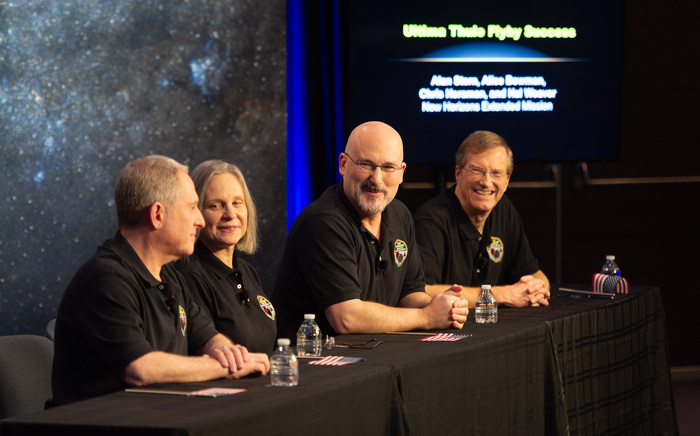
Here we have Alan Stern, Alice Bowman, Chris Hersman, and Hal Weaver.
Alan Stern: "How was last night for me? I don't know about you all, but I went back to the hotel, had a great 8 hours sleep, not nervous at all. I knew our spacecraft and team did it before, and could do it again."
Hal Weaver talks about the rotation of Arrokoth -- which we should have known for months, but are just starting to figure out now, in the last day.
Alan Stern: "Now, here is the best pic we have of the UT from before flyby. It's ok to laugh, but it's a lot better than the one we had the day before!"
Hal Weaver: "Now, this is a pixelated blob. But it's a much better pixellated blob than we had before!"
But even now we have ambiguity in its rotation rate! The problem is that the rotational axis is pointing straight toward us, so its size and shape always look the same to us.
Kelly Beatty, Sky & Telescope.
Alan Stern talks about rotation rates.
MIssion Ops Manager Alice Bowman gives an update on how well the spacecraft did (answer: perfectly).
Alan Stern, Alice Bowman, Chris Hersman, and Hal Weaver chatting with the media afterwards.
Mike Buckley and Geoff Brown.
Jason Mackie with Augie! Augie has changed out of the orange astronaut costume from last night, into something more comfortable.
John Spencer and Mark Showalter.
___ and Yanping Guo, our main trajectory engineer. She is the one who designed our flyby past Pluto, and then past Arrokoth.
Navigators! That's Simon Porter, Derek Nelson, Erik Lessac-Chenen, and ___.
OK, Simon Porter is not really a navigator, but he worked with the KinetX NAV team a lot in terms of analyzing the OpNav and occultation data, to determine where the spacecraft was headed and when it would get to Arrokoth.
The KinetX NAV group!
Adriana Ocampo and Hal Weaver, with Walter and Milly Alvarez at the back.
Whoa! It's Jim Baer, of Ball Aerospace! I worked with Jim in about 2004 as the Ralph instrument was being designed, built, and tested at Ball in Boulder. All the Ball people have long-since moved on to other projects, but it was really cool to see Jim show up for the flyby.
Jim is pointing at the Ralph instrument. One portion of that is LEISA, the Linear Etalon Imaging Spectral Array. Ball program manager Lisa Hardaway passed away in 2017, and the LEISA spectrometer which she helped to develop has been renamed in her honor.
Me with Jim Baer.
NASA's chief photographer Bill Ingalls doesn't have enough cameras to carry.
And we're back in Building 200! The public has mostly gone home, and there isn't a press conference for another 24 hours. And now our work on the data begins! The high-res images of the flyby will be coming back soon. Simon Porter updates that calendar to show we're at K+1d, and Arrokoth is now 700,000 km behind us.
Simon Porter: "Hey, can you take a picture of me at my desk?"
I love this shot. In addition to the five laptops, you can see Tod Lauer's daughter's drawing of the Hazard team and a signed T-shirt of the same, Simon's handheld espresso pump, two Hazard Team helmets, Mark Showalter's Star Trek jersey, Marc Buie's 3D model and his Yerba Mate infuser from the Argentian expedition (which he drinks constantly), Marc's "Please do not move this chair" sign for the cleaning crew (it didn't work), takeout soy sauce packets, a schedule of downlinks, Mark's M&M's, and mousepads from both the Moon and AGI, who makes our trajectory analysis software.
Oh, look at how red Tod Lauer is getting. We're all watching Andy Chaikin's laptop. Is it new data? Or is it a movie of Carl Sagan, talking about the Voyage to the Meat Planet? You decide...
Andy Chaikin, Jeff Moore, and Bill McKinnon try to figure out what data are coming down next. How do to that? As always, turn to Kelsi Singer's ever-helpful 'playbooks,' which list every observation by every instrument, listing when it executes, how many images, exposure time, and when it's scheduled for downlink. They're made of real printed paper, and we'd be lost without them!
Andy Chaikin.
Just before 6 PM on January 1. Simon Porter sits at the center as the first flyby data start to downlink. You can see on the screen at the front the first few rows of the data (the horizontal grey bar toward the bottom of the screen). And you can see that Arrokoth is probably in the image, on the right, because of the 'image readout smear' -- CCD artifacts that cause bleeding of bright pixels into the rows below them. The data are coming down row by row, with more data every few minutes. Simon is hitting reload over and over again.
Surrounding Simon, from left: that's Amanda Zangari, Jeff Moore, Andy Chaikin, Anne Verbiscer, Andrew Steffl, Ted Stryk, Bill McKinnon (back), Tod Lauer, John Spencer (with camera), Carber Bierson, Alan Stern, Chloe Beddingfield, and Rajani Dhingra.
Oh look! We have a few more rows downloaded! APL's videographer Lee Hobson is watching, and a few more people have shown up, including LORRI Instrument Scientist Andy Cheng.
Simon Porter talks about the readout smear, as we try to figure out the geometry of the downlinking observation. The image is still coming down, as seen on the laptop in the foreground. "So it must be that MU69 is on top, because..."
Marc Buie gets pre-emptively excited about the shape.
Marc: "I will bet you anything. This is what it's going to look like. Single body, two lobes, the bottom one bigger than the top. There's no other way around it. I will shocked if what we see is not exactly like this model."
Still waiting for the image. It's been almost 10 minutes. Marc Buie's computer is decorated with another 3D model, this one made of clay in the shape he predicts.
A few more rows have shown up and are visible on the laptop, although we still haven't hit the target. Brian May comes into the room (in the red just outside the door).
12 minutes now. WE WANT MORE DATA!!! The data are being downlinked by NASA's Deep Space Network. The packets of raw bits are turned into imaging data at the Science Operations Center in Boulder, and then sent to us at APL.
And we have it!!! At the back of the room, Stuart Robbins reloads from the SOC machine at the right time, and is the first to get the whole image on his screen, at 6:07 PM. Everyone races to the back of the room.
And there is it is!!! Stuart brings up the FITS file in Photoshop for a bit of quick constrast-brightness tweaking. We have the whole image, it's centered, it's beautiful, and it's right there.
Much of the team has come over now from the other rooms nearby, and it's exciting. This is the CA01 image, taken by LORRI. CA = Close Approach.
Since the position of Arrokoth was still uncertain, we actually took 102 images in a line, with the expectation that Arrokoth would be in that line somewhere. We downlinked only the central few frames initially, and we nailed the position. Nice job, Nav team!
And here's the CA01 Arrokoth image itself! Resolution is 350 meters per pixel. Our best images hit 33 meters/pixel -- that is, 100 times more pixels than this -- but they will not be downloaded for another month.
Paul Shenk has no idea what it is.
Yeah, it's pretty exciting.
And look at that! Marc Buie led the occultation campaigns, which were by far the most logistically complicated ground-based solar system astronomy project every undertaken, and he nailed it. Shape, size, albedo, position -- all right on.
Marc: "You know, someone needs to tell David Nesvorny. Because this is exactly what he has been predicting that KBOs would look like for all these years based on theory."
That's some excitement, as John Spencer and Marc Buie have led the team to the target. Tod Lauer and Jeff Moore and next.
Hal Weaver and Tod Lauer! What an amazing moment it is to see that first image.
Marc Buie takes his victory lap through the GGI room.
John Spencer leads a roud of applause for all the team members, from Navigation, to Hazards, to G&C, to sequencers, to engineers, to Mission Ops.
Veronica and Oliver
Stuart Robbins and Veronica Bray count craters, while Orkan Umurhan watches..
Stuart: "Here's one..."
"Here's another..."
"There's seven craters I can see on the surface! Seven!"
(By the time of the plenary, they've found three more, up to a total of 10.)
9 minutes after the image is down, and Jeff Moore has called to order the GGI Team Meeting. It's time to start getting down to business! There's APL's Lee Hobson shooting video, and APL's Ed Whitman on the right shooting stills.
A few important orders of business!
What do we call them? "Well, lacking any better suggestions, right now let's call the big one Ultima, and the small one Thule."
Are there any moons? A: These three dots, they're all stars. No one sees any satellites yet (much less rings).
How big are they? A: 6.5 km and 9.4 km. And they are roughly round.
Ed Whitman talks wth Marc Buie about his shape models.
Brian May enters the discussion. From left, that's Randy Gladstone, Janet Vertessi, Jason Cook, Andrew Steffl, Paul Schenk, Lee, Brian May, Stuart Robbins, Joel Parker, and Andy Chaikin.
"My model is better than your model!" Andy Chaikin and Jeff Moore hold up their respsective Arrokoth 3D prints (made from before) to compare which one could give is the right projected profile.
Alan Stern looks at Arrokoth, while John Spencer tilts his head to see Tod Lauer's inverted version.
Bonnie Buratti has finished doing the initial calculation of albedo.
And the albedo is... 0.11! It's a dark object.
I love seeing Bonnie's calculations here, because it looks just like my homework during grad school. Factors of R2/r2, 2.5 log P, sketches of triangles, Mpl - Msun, couple factors of Π r2, length of a hypotenuse, and on and on. What we do as astronomers is just what we did as high school physics students -- we just have been doing it for longer.
Marc Buie talks with Leila Gabasova about the shape. Marc's pointing at the scren, and comparing the real shape, with that of his 3D clay model he made a month ago.
APL photographer Ed Whitman. Ed was a commercial photographer for 20 years before joing APL.
"Yeah, I had a studio in Silver Spring. Advertising, corporate, portraits, everything. Bosch used to send me a whole case of their power drills for the next season, and it was my job to go shoot them. But yeah, I get to shoot some great stuff here. I was gone for a lot of the summer, actually. I was working at Cape, shooting the integration and launch of Parker Solar Probe. Really cool experience. APL put together a book with a lot of the shots. Let me see if I can find one for you."
Helene Winters told me that that one of Ed's shots was the winner in Aviation Week & Space Technology's 2018 photo contest: 5th photo in the gallery, of the APL-built Parker Solar Probe sitting on the launchpad.
Mark Showalter: "So, the solar vector is up here, and the rotation pole is 90 degrees off from that, and we're seeing rotation along the boresight, but the image is flipped 180 degrees in Tod's deconvolver from the other image. And then we flip the spacecraft upside down remember on the outbound trajectory, so that would put the sun over.... Uh...."
Necessary equipment: computer glasses, M&M's.
We'd be lost without either of them: David Aguilar left Harvard CfA's press office to run New Horizons' media programs at the Pluto flyby, and he returned for Arrokoth. And Cindy Conrad, who keeps Alan in line.
Ann Harch did a lot of the uplink sequencing. And check out that fancy name badge that she made up. They're done by her friend space artist Steve Thomas, and Ann printed up custom commemorative badges for everyone. Anne Verbiscer spent many months organizing the Arrokoth occultation campaigns in South Africa and Senegal.
We've had the image down for an hour, and Paul Schenk (Carver Bierson?) is fitting shapes to the two bodies. Shown in the panel below is the residual topography, showing ridges and 'mountains' of up to a half kilometer, above the ellispoidal shape.
Alan Stern: "Look at what Ted made up! One the left is what MU69 looked like in 2018 last night. A new year, and look what Arrokoth looks like now. I'm loving 2019! Ted, can I use this in the press conference?"
We're still trying to piece together Arrokoth's rotation rate. It's now well after the flyby and we still don't quite have it nailed down. Mark has laid out a timeline of six snapshots of Arrokoth. But the target could be rotating on any axis, and it might rotate any integer number of times between our images, so...
But Mark thinks he has it. Look at that dipslay window of PCalc on his computer.
"Attention everyone! The rotational period is 15.35 hours."
So finally, after months of nothing and a day after flying past it, we finally have measured the most basic parameter for our target.
Tod Lauer and Andy Chaiken discuss sharpening techniques in front of a DS9 window.
Mark Showalter is thinking hard about rotation rates.
Mark Showalter is thinking hard about rotation rates.
The team hard at work discussing the rotation.
John Spencer and Tod Lauer.
In the GGI room, everyone is at work. We have another full day until the next image comes down. The team now is set to work around the clock 24-7 -- two science teams, in alternating 12-hour shifts. In reality, no one wants to acually leave -- unlike Pluto, there were so few downlink events for Arrokoth, that everyone wanted to be there for them.
Kelsi John Spencer, Kelsi Singer, and Tod Lauer.
Ooo! Now we've headed into a new phase, with the use of 3D viewing. We ended up doing a ton of 3D visualization on Arrokoth, and it was much more important than on Pluto. With Pluto, it ws a big ball, 2400 km across, and it was very obvious what was a crater and what wasn't. But with Arokoth, nothing is obvious -- even the shape of what we're looking at. So, Marc Buie is playing with 3D glasses, to see if he can construct any useful image pairs. You can see the edge of one 3D assemblage on the screen at the bottom.
Mallory Kinczyk is making a 3D model of Arrokoth out of clay.
Mallory Kinczyk
Grad student Mallory Kinczyk has been enlisted to make 3D models of Arokoth out of clay. So she does the best she can to fit the data (which is mostly one image) to a ball of clay.
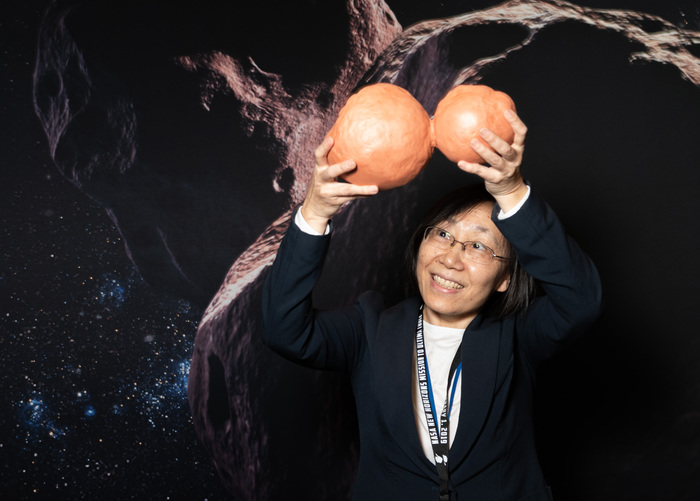
Mallory Kinczyk and Kirby Runyon are digitizing a newer, larger 3D model of Ultima Thule. This is one she's made out of clay, foam balls, and barbecue skewers. Kirby will clean up that 3D model and 3D-print a copy of it.
Note that we're modeling it as two spheres. As it turns out later analysis showed that the larger one was more pancake shaped... but we didn't know that yet.
Brian May and Paul Schenk.
John Spencer has done some edge-detection to try to look for surface features.
Dan Britt in front of our daily update board. At K + 1 day, we're outbound from Arrokoth, at 0.004 AU and 700,000 km. (One day, and we're almost a million km away already!)
Presenting the first flyby data at the plenary session, 10 PM on New Years day.
Alan Stern: "Now, this is really good work everyone. And keep in mind, 100% of everything we've done til now is gonna be superceded by what we get by breakfast time tomorrow morning. "
Jeff Moore tries to make sense of the rotation story for Arrokoth.
And check out how well that shape matches the occultation profile!
Jeff Moore: "You can all restore your faith in occultations. We fit it perfectly. Congratulations to everyone. I mean... this is from ultimately a bunch of amateur Dobsonians. Wow -- what a shape!"
Cathy Olkin and Alex Parker in the plenary session.
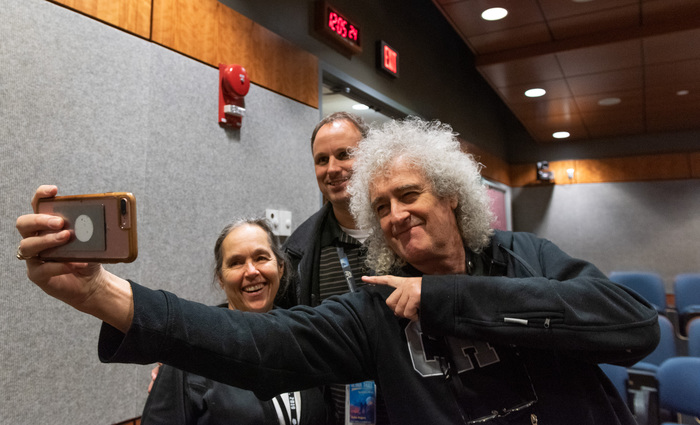
It's hard to hide with hair like that. Brian May snaps a shot of his favorite Kuiper belt object.
We're up to 10 potential craters on the surface!
Jeff Moore: "Now of course Stuart can't contain himself, so here's his crater count..."
Stuart Robbins: "It wasn't me, it was Veronica!!"
Oooooh! January 1 and we already have the first take on an MVIC spectrum. Check out those two fabulous data points! (The third one is a laser pointer.)
And check out that high-fidelity LEISA spectrum! The red curve is Nix; the white lines are Arrokoth. OK: big error bars on the right, but it's a legitimately red spectrum out to one micron.
Helene Winters holds up the most important piece of paper: the downlink calendar for December 31 through January 2. Each line corresponds to one set of observations, with one instrument. This isn't a complete list of all observations -- just the high-priority ones to be sent down as soon as we could.
The two data sets that we're really looking for here are those labeled CA01 and CA04. The former what we just downlinked, and the latter will come down later tonight. These are interspersed with data from MVIC, LEISA, and the other instruments.
It's 11:30 PM and Anne Verbiscer and John Spencer are back on the impromptu set of NOVA in the APL lobby, discussing the day's initial downlinks and first science results.
Walter Alvarez, on the right, was the first one to demonstrate that the end of the dinosaurs was due to a giant impact. Here, he holds a model of comet C-G and chats about what might have happened if it hit the Earth instead.
Ramy Elmaarry self-identifies.
Walter Alvarez, Henry Throop, and Simon Porter, with their favorite binary objects.
Simon Porter checks out the gravimetric map of the Yucatan, with Walter Alvarez.
Jeff Moore at the GGI podium. These are low-res images, not anything new.
Jeff Moore has everything he needs to do science: 3D glasses, a paper plate, and a lot of ethernet cables.
Ooo ooh! 12:24 AM and it's time for another image to come down! Stuart Robbins gets excited as the first four rows of the image have shown up. Just 1020 more to go! (This is a LORRI 1X1 frame, meaning it is at the full 1024x1024 resolution.)
Simon Porter watches as some more of the image slowly downlinks. You can see that Arrokoth will be on the right-hand side of the frame -- that's readout smear that causes the bright pixels to bleed into the dark sky. Usually it's much fainter, but the image here is stretched so we can see anything that might be there (rings, satellites, etc).
Simon is pacing.
Anne Verbiscer, Paul Schenk, and Andy Chaiken are waiting...
A handy table of what to expect, from Kelsi's playbook for CA04.
One of my roles on the mission was developing Geoviz, which is the software used for several of these plots.
12:45 AM. Oh look -- Orkan Umurhan points as we finally have Arrokoth!! You can see its limb just barely grazing the downlinked rows at the middle of the frame, above Stuart's head.
12:46 AM: We have a few more rows...
12:48 AM: Paul Schenk prays to the image gods. "GIVE US MORE DATA!!!!"
12:54 AM. It's been nearly half an hour on this frame, and we still have only a few rows downlinked. With Jent Vertessi, Remy Elmaarry, Anne Verbiscer, Maria Banks, Orkan Umurhan, Cathy Olkin, Paul Schenk, Bill McKinnon, and Andy Chaiken.
And just moments later, Stuart Robbins is the first to get the full image on his computer! Around him from the bottom are Orkan Umurhan, Maria Banks, Rick Binzel, Jeff Moore, Cathy Olkin, and Ted Stryk.
The image was originally scheduled to come down around 5 AM, according to the playbooks. But it ended up downlinking at about 1 AM, four hours earlier than planned (perhaps due to a time zone issue, not sure). Much of the imaging team was asleep, and APL's photographers were not there either.
This is the CA04 dataset -- taken at a resolution of 140 meters per pixel. It's a set of three 1024 x 1024 LORRI frames, and this is the central frame. The other two frames overlapped slightly.
The CA04 image of Arrokoth is down!
With Stuart at work to do some quick image processing on contrast and sharpening, Simon starts to point out features at the front.
The previous CA01 image showed the shape well. This image, CA04 was taken 30 minutes later (= 15,000 km closer), and shows far more surface detail.
Our best image overall is the one known as CA06, taken another 40 minutes later, very near close-approach at 3500 km above the surface. CA06 is a series of 892 images, all LORRI full-res 1024x1024 frames, 0.025-second exposure, at a best resolution of 0.03 km/pixel. Due to limited bandwidth and Arrokoth passing near the Sun in the sky, that image sequence was stored on the spacecraft and didn't downlink til February 2018, two months after flyby.
And here is the CA04 image! Resolution is 0.14 km/pixel -- better than double the 0.31 km/pixel resolution of CA01. This image was taken about 30 minutes later than CA01.
This particular image sequence was 244 exposures, 0.1 second each, taken every 3 seconds. The idea is that Arrokoth was going to be somewhere along this line, but we didn't know where. As it turned out, our navigation was very good, and we ended up with the Arrokoth image right in the center of the 244-image sequence, with 240-some frames of empty sky surrounding it. I would say it is 'unbelievable' we nailed it so perfectly, but it's due to the hard work of the Nav team, the occultations, and the approach imaging, that we were able to take this image.
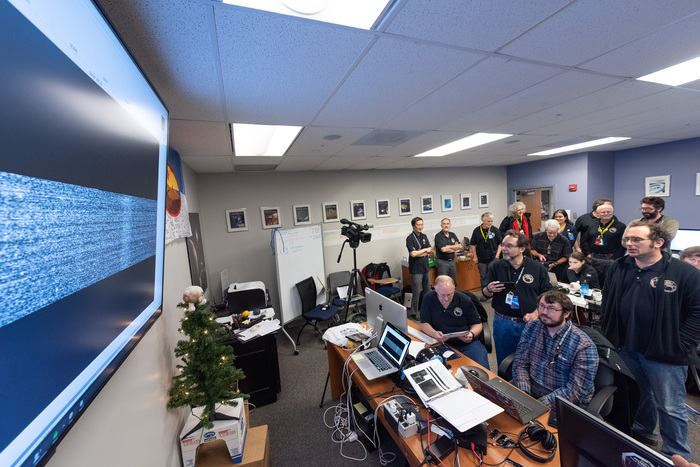
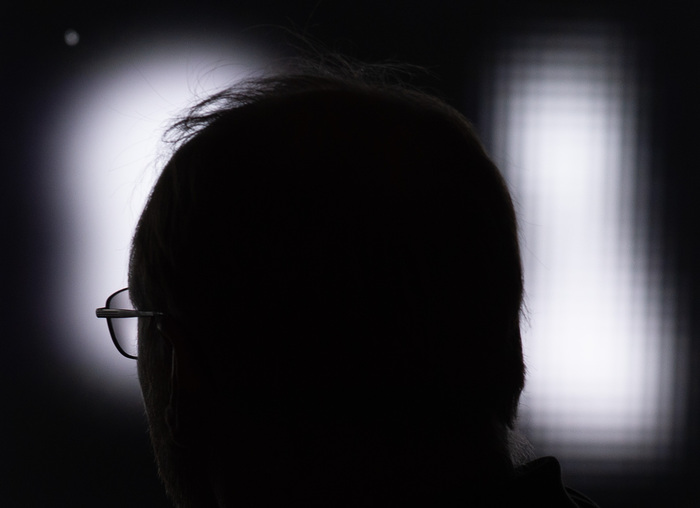
Maybe my favorite picture of the encounter. 12:58 AM, four minutes after we've got the image. It's quiet, and we are all just staring at what we have. From left: Carver Bierson (?), Tod Lauer, James Tuttle Keane, Jeff Moore, John Spencer (seated -- he is projecting from his laptop), Remy Elmaarry, Cathy Olkin (obscured), Andy Chaiken, ___, Rick Binzel, Orkan Umurhan, Anne Verbiscer, Janet Vertesi, Alex Parker, Simon Porter. Finishing out the scene is Amanda Zangari's festive tree, which she brought in for our through-the-holidays Hazard Team work, and the signed flag from the occultation campaign to Comodoro, Argentina, where we first nailed the occultations and determined the shape and size.Tod Lauer points out the spooky similar
Tod Lauer wrote to me in an email a year after the encounter:
"It just occurred to me where else I had seen that incredible image of all of looking at MU69 in an incredible moment of discovery.. 2001: A Space Odyssey. My favorite movie, which remains an incredibly powerful vision and statement 50 years later. It is not like any movie made before or since. More than anything it's an invitation to your imagination. It is profoundly visible - the story told in images."
Cathy Olkin points out features to James Tuttle Keane.
Hallelujah!
A year after encounter, Tod Lauer wrote this to the team:
"The Arrokoth encounter was an explosion of energy the likes of which I had never seen. Pluto was a stately cruise by comparison. The parts that stick with me the most are the incredible jam sessions we had in the GGI room. You recognize great musicians by how they speak uniquely through their instruments. So it was when we gathered to put all the pieces together. So many different voices and different ways of thinking. Some of us viewed the incoming data with strong rigor and deep skepticism against quick pat answers, while others bounded about with intuitive leaps. Some were shy, some bold. Some spoke only to provide deep knowledge, others sketched out where knowledge was needed. And all of this intersected in myriad ways with our particular technical specialties. Overall I was startled by how quickly we were able to sketch a good first draft of what Arrokoth was trying to tell us."
"I think the best summary of the encounter is this incredible tableau that Henry Throop captured. All of us deep in the moment of discovery, lost in our thoughts, probably all different in detail, but common in trying to figure out what to do next."
Here are the two high-res images, compared. At the left is the CA04 frame downlinked 5 minutes earlier. And on the right is CA01, which came down 10 hours earlier.
CA01 and CA04 next to each other. They were taken with 30 minutes between them, so they show slightly different angles on the same body.
Here are the two high-res images, compared. At the left is the CA04 frame downlinked 5 minutes earlier. And on the right is CA01, which came down 10 hours earlier.
In the back row: Andy Chaiken has a plan, as Ted Stryk, Jeff Moore, and John Spencer look on.
Check it out: it's Arrokoth in 3D! Because the two frames were taken from a slightly different perspective, they can be assembled into a stereo image. Andy thinks he has the orientation figured out properly to show something in 3D. He puts together an image pair, and uses a pair of Brian May's stereo glasses to view it. These glasses were borrowed from a copy of Brian May's 3D Moon book, which John Spencer had brought in.
The book is very cool, and a lot of contains 'serendipitous' 3D observations just like this one. You don't need to take along a discrete 3D camera to make 3D images. If you take two pictures of the same thing from different angles or different times, you can often shift and scale the images so that they'll make a good 3D pair. Brian May is great at this, and he contributed a lot to this effort later on.
3D Arrokoth!
Ted Styk looks at that 3D Kuiper Belt Object!
Meanwhile, Paul Schenk has made his own 3D version using red-green glasses, rather than a lensed viewer.
Stuart Robbins gets in on the 3D action.
Jeff Moore and I check out Paul's 3D version as well.
Meanwhile, there's a rumor that in the Composition room ('COMP'), that team has new goodies. And check it out: here's Alissa Earle, Alex Parker, and Silvia Protopapa, with a true-color rendering of Ultima Thule!
This is the APROTH (APproach ROTational, High-resolution) dataset, taken at 1.5 km/pixel. MVIC isn't as high-resolution as LORRI, so they've taken the low-resolution MVIC color data and layered it with the high-resolution LORRI CA04 data to make the image here. Ultima Thule is red!
One by one, people start coming over to the COMP room to see what's up. Ted Stryk checks it out.
Check out that beautiful MVIC Arrokoth color image! With Rick Binzel, Alissa earle, Alex Parker, Ted Stryk, Carly Howett, and Silvia Protopapa. The paper image that Rick is holding is a false-color plot of the MVIC data. Nice sketches of Arrokoth on the whiteboard as well.
Carly Howett and Alex Parker.
Paul Schenk's rotational period notes.
The list of constraints and hypotheses in the GGI room.
Bilobate - radii of 9.1, 7.1 km"
"15 hr rotation"
"no satellites observed"
"I/F variation of 2 - probably topographic and albedo"
"Neck feature is brighter and less red"
"Hypothesis: Formed under same condition? Similar location?"
"Age?"
"How to remove L [angular momentum]?"
"How to preserve the neck?"
"How to preserve spheres?"
I leave APL for the hotel just before 3 AM. In the parking lot I come across NH's Guidance & Control lead, Gabe Rogers.
Gabe: "That late-night shot you took in the parking lot? I would call that picture 'Peace,' because that is what it felt like for the first time in months. I finally got to relax, if just a bit."
I get to the hotel (it's a 5-minute walk from APL) to find Orkan and Tod in the lobby at 3 AM.
From one Brit to another: Fran Bagenal wants Brian May to sign her 3D Moon book.
It is a great book -- Brian has taken a lot of the Apollo images and turned them into 3D images. But he hasn't done this just by creating arbitrarily the depth data. In most cases, what he's done is scour the Apollo data to find two images of the same scene, taken from slightly different positions. Then he shifts and rotates as necessary to make a natural stereo pair.
Flight Controller Becca Sepan looks at the solar system in 3D courtesy of Brian May and his viewer.
When not in the music or zodiacal dust worlds, Bri has spent a lot of time in 3D imagery. You can buy several books and 3D image sets he's produced through his London Stereographic Company.
Erik Lessac-Chenen, Helene Winters, and Derek Nelson.
Ann Harch and Erik Lessac-Chenen.
Erik Lessac-Chenen, Ann Harch, and Derek Nelson.
Erik Lessac-Chenen, Ann Harch, and Derek Nelson.
Derek Nelson gets ready to depart. He's headed to Lockheed-Martin in Denver, where he and the rest of his group at KinetX will be doing navigation for OSIRIS-REx.
While we are of course excited by New Horizons and talk about nothing else, there are other spacecraft in the solar system. By coincidence with our January 1 2019 flyby of Ultima Thule, OSIRIS did its first orbit insertion burn at asteroid Bennu on the very same day! It was a huge accomplishment for that mission.
Derek:"Bennu is just so small, a completely different realm than even MU69. I mean, it's 500 meters, and OSIRIS is going to be orbiting it. I like to think of it as a turtle orbiting a small building. The speed is about right -- just a few centimeters per second."
Ann Harch.
Ann Harch and Rick Binzel.
Kelsi Singer -- who has spent the last few years looking at he cratering history of Pluto -- talks with Walter Alvarez about impacts.
Lisa Turner: "Before coming to APL, I was actually a paralegal. The firm I was at specialized in divorce, so it was depressing -- I was always dealing with people at their worst. And here, I get to work with people at their absolute best."
Sarah Levison puts some Lucy memorbilia on Brian May.
Brian May and the Lucy mission!
Brian May, Sarah Levison, and Hal Levison. Hal is the PI of NASA's Lucy mission, which is the most recently selected Discovery mission. It will launch in 2021 and visit five Trojan asteroids near Jupiter.
Brian May and Hal Levison both fully endorse NASA's Lucy mission.
David Aguilar and Brian May spend some time chatting about CGI modeling of the solar system and exoplanets.
David Aguilar wants a signed book too! That's Brian May's 3D lunar photography book, which is pretty sweet. Most of the pics were not taken originally as 3D, but he has very carefully gone through video, or image pairs taken in quick succession, and found ones that could be put together to make an actual 3D image.
In the foreground are some of Brian May's 3D stereo astronomy card decks. They're great images, where he has very carefully found real data that can be made into image pairs and projected into 3D.
Walter Alvarez, Ann Harch, and Kelsi Singer.
A complete set of autographed Brian May team photos!
Oooh -- a step back in time! I took some pics of Brian May with the science team back when he visited just after the Pluto flyby. I printed out some of those photos -- from three years earlier -- for him to sign and distribute. Here's Leslie + Brian of today, with a Leslie + Brian of 2014.
The 2014 photo is of Leslie using Brian's 3D viewer to visualize the latest Pluto images just after flyby. "Oh my god! I've just been out-geeked by a rockstar!"
Hong Kang, G&C engineer, with a Brian May photo from the 2014 Pluto flyby.
There's a photo I like from the 2015 Pluto flyby of Alice Bowman looking up at Brian May. Alice is holding a copy of it here as she re-enacts it, looking up at fawningly at Bri.
It's YouTube sensation Tim Blais, who has come for a visit. While working on his Physics PhD, Tim got slightly distracted by the music world, making YouTube hits such as the quantum physics-themed Bohemian Gravity (5 million hits -- yes, based on Bohemian Rhapsody) and Outbound Probe (6 million hits). Naturally he wanted to connect with Brian May, so Leslie Young inited him to come by.
Tim: So when did you finish your PhD?
Brian: WelI, I finished the observations in 1970. But then I didn't turn in the PhD until 2000. Yeah, I had some other things come up, I guess.
Tim: Oh! I turned in my MSc thesis five years ago, and I haven't been back. So I guess there's still hope!
Tim Blais plays the Theremin app. It senses your hand position not using an antenna, but with the built-in flashlight.
The theremin app is really really fun to play. However, I admit it is a lot more fun to play the Theremin, than listen to someone else play it.
Leslie Young tries to explain the geometry of the Arrokoth flyby.
"So you have the spacecraft over here, with the orbit normal along this plane. And then MU69 has its rotational axis almost exactly aligned with that, which puts it at 90 degrees to the equatorial plane. Now, for the MIVC scan, we spun the spacecraft in this direction, which means that the Sun must've been over here. Now the asymptote is at 160 degrees outbound, and -- so, you can just invert the matrix, and then you've got the rotational pole. It's simple."
Brian May takes a selfie with Ann and Gabe.
Ann Harch and Gabe Rogers worked together for years years trying to get this flyby sequence down.
Doug Hamilton and Orkan Umurhan discussing dynamics in the hallway.
We're back in the K-Center for the January 2 press conference. At center are Marc and Joan Buie.
Alan Stern heads up the press conference. This is the press conferene where we're going to release the LORRI CA04 image that we received about 24 hours earlier.
Alan Stern: "And what does it feel like to our team? Let me just show you a couple pictures. I think you can tell how it feels."
Alan Stern: "Just look at that team, as we saw these high-resolution images come down for the first time."
Alan is showing a couple more of my photos at the press conference -- this one of Tod Lauer and John Spencer in huge hug after the first image.
At the press conference, revealing for the first time the shape of Ultima Thule, sketched in red. And that's overlaid with the overlaid with the white lines, which are the shape predictions from the occultations. The match is exact.
"But of course it's right. What else would you expect?" says Simon Porter.
Deputy Project Scientist Cathy Olkin talks about the variation in albedo across Arrokoth. Usually a lot of the variation would be caused by topography (i.e., shadows). But here, we are coming in at such a low phase angle, that shadows and lighting variation are minimal, so a lot of the visible brightness difference is due to reflectivity variations.
Carly Howett shows the MVIC color frame (left), merged with the LORRI high-res monochrome image (center), yielding the synthetic high-res color image at the right. You can see how there is real color variation across the image, in particular on the white 'neck' and some lumpiness on the smaller lobe up top.
Talking about possible surface features on Arrokoth.
James Tuttle Keane is a geophysicist at Caltech. But when he's not calculating, he's sketching. Here's artwork for one of his many pieces throughout the flyby.
Bill and Diane Merline!
After the press conference, it's time to head back to APL's Building 200 to do some science. Here are Casey Lisse, Heather Elliott, and Dough Hamilton doing just that.
Heather Elliott in front of APL's Space Building.
Oh wow! OK, I walked back to the Homewood Suites and came into the lobby. There was a big group assembled, all watching TV. But hang on -- they're TV producers, and they're watching us on TV! This is so cool -- this was the premiere of the show that NOVA put together about the Ultima Thule flyby. It was airing right now... and the NOVA production team and a bunch of the science team were all watching it live. That's Arrokoth at the center, as seen from Hubble.
I assembled all of the NOVA crew for a group shot. At the center is Terri Randall (of Terri Randall Productions, who put the show together for NOVA). And below are us: Amanda Zangari, Anne Verbiscer, Hal Weaver (wearing a classic hat from the NH launch in 2006!) and Joel Parker.
Srinivas Laxman files a story for the Times of India from the lobby of the Homewood Suites. Check out that handwritten reporter's notebook!
Chris Hersman, Melissa Jones, and Mark Tapley enjoy a bit of food-truck action. We were working through the holidays -- basically Thanksgiving through early January -- so the food trucks kindly took care of us when APL's cafeteria was closed.
Time for some more food-trucking! With Dale Cruikshank, Ted Stryk, Carver Bierson, Veronica Bray, ___, Henry Throop, Kirby Runyon, and Jason Cook.
We took a field trip to Bethesda for some nice Maryland blue crabs.
Mark and Simon with their crabs at Looney's.
[Photos taken earlier during a rehearsal -- we didn't have time for crabs during the flyby itself!]
Oh look! Guess who's going to ace the trivia-night answer at Looney's?
Eating at the APL cafeteria!
Taco truck, in the rain! The APL cafeteria was closed for much of the encounter, so we are thankful to the food trucks who visited APL!
Bistro Lunch Box! I remember this truck coming by to visit us during the 2015 Pluto flyby, and they're still serving great sandwiches and truffle fries!
Orkan Umurhan walks over to the K-Center with me for the final press conference of the week.
"So, let me tell you. My wife, she is an archaeologist. And she spends all this time on digs. And the way archaeology works now... well, they do the dig, and they document everything. And they remove it. And then -- well, they have to destroy it, because when you remove all the layers like this, archaeology is intrinsically a destructive process. So there was an oven -- it was in Greece, thousands of years old. And we had to destroy it. It sounds completely crazy and incorrect, but this is what they do. So the head of the research group, they gave me the hammer, and told me to break it. And I went like this, and this, and this...."
It's January 3, and we're at the flyby's final press conference, before the team is dismissed to go home. Looks like everyone has 3D glasses... hmm!
Sitting down that's Andy Chaikin, Jane Spencer, John Spencer, Gordon Bjoraker, Marc Buie, and Tod Lauer, with APL photographer Ed Whitman looking over.
In the press conference, Heather Elliot and Joel Parker, among others.
Silvia Protopapa talks about Arrokoth's color and composition at the final press conference.
Each press conference highlighted different people, doing different science. Here, Leslie Young is talking about the solar wind interactions that we looked for at Arrokoth.
Alan Stern and Mark Showalter talk about Arrokoth's true shape, helped along by some 3D glasses and a model.
NASA Chief Scientist Jim Green likes to live in three dimensions.
(Who is this? She was at many of the press events but I don't know her!)
That's Alan Stern, Mark Showalter, Leslie Young, Silvia Protopapa, and Paul Schenk.
And three more! The mission also brought up three scientists who were working on the artistic side of things: Mallory Kinczyk, Leila Gabasova, and James Tuttle Keane. Here's Mallory posing with one of her clay Ultima Thule models.
Chris Hersman and Gabe Rogers.
Gabe Rogers and Chris Hersman.
Gabe Rogers and Chris Hersman go through a geometrically correct replay of the entire flyby sequence. Gabe makes sure to minimize thruster usage while still keeping LORRI pointed at the target.
Tod Lauer (0.9 mm/pixel) poses next to a shot of his favorite KBO Arrokoth (100 meters/pixel).
Yanping Guo has been New Horizons' trajectory designer since the start. Her nominal trajectory, which we flew, took New Horizons 3500 km from the surface. Here, Yanping checks out what Arrokoth looks like from a distance of 9 inches.
Srinivas Laxman with New Horizons, Gabe, and Chris Hersman.
Marc Buie and Chris Hersman prepare for the Arrokoth flyby.
Chris Hersman and Marc Buie do a geometrically correct re-enactment of the flyby.
David Vespoint, Kerri Beiser, and John O'Brien. Kerri runs the education program for APL and New Horizons, while the other two run APL's audio/visual production group.
And who else is behind the scenes on media? That's Geoff Haines-Stiles and Art Howard.
Walking back to Building 200 after the final press conference in the Kosiakoff Center. You can see APL's main entrance behind. From the left, that's ___, Heather Elliot, Paul Starkis, Leslie Young, and ___.
Lisa Turner and David Aguilar think about big ideas.
Rajani Dhingra came up to me in the GGI room. "Hey, my paper at the University of Idaho is running an article on me. Can you take a photo I can send them?"
So we went out into the hall, and took a bunch of photos of her holding the 3D-printed Arrokoth model. We came back, and I edited them. This was the best one, but it was kind of... meh. Plus, I had her hold Arrokoth on the wrong side, so the New Horizons logo wasn't even visible. So even though that was the best one, I told her we needed to try again.
Definitely better on the head.
Giving up on the earlier photos, I had Rajani Dhingra toss the Arrokoth model, and that did it. I love this pic. I shot about 50 frames, and this was the winner.
And then, Silvia Protopapa and Carly Howett walked by and asked what we were doing throwing 3D Arrokoths around, so they stepped in...
Oh look! Carly Howett has Arrokoth flying in front of her!
Ted Stryk lies on the ground and tosses Arrokoth in front of Carly, again. All the sacrifices one makes to humanity for a good photo!
There are a few leftover badges! These are for the visitor area at the Kosiakoff Center.
Joel Parker: "Hey, can we take a photo of all of the SwRI people who are still here?"
So we have from the left: Rayna Tedford, Brian Enke, Kelsi Singer, Randy Gladstone, Andrew Steffl, Leslie Young, Joel Parker, Alan Stern (with the ceremonial roadrunner), Cindy Conrad, Silvia Protopapa, John Spencer, Stuart Robbins, and Carly Howett.
Joel, Silvia, and Carly take things into their own hands during the SwRI photo shoot.
And here are our valuable staff, keeping out any riff-raff for the week, bringing in lunches, getting us badged, and on and on. From left, that's Ted Stryk, Rayna Tedford, Helen Beyer, Maria Banka, and Cindy Conrad.
One final event of the flyby: we gathered in New Horizons' Ten Forward lounge at the Sheraton. Tom Krimigis is the former head of the Space Department at APL, and was ran the lab during most of New Horizons' development and flight. He gives a toast to the crowd. Visible behind him are Yanping Guo, Kelsi Singer, James Tuttle Keane, and Andrew Steffl.
Alan finds a binary lobate object in his beverage. It's a sign!!
Mark Showalter was head of the Hazards Team, which was responsible for identifying any moons, rings, or dust that could be along our trajectory in space as we passed Arrokoth. We spent two years prepping for the encounter, and a month of long days at the lab analyzing data as it came down from the spacecraft. One of the possible threats to the spacecraft were a new type of ring discovered theoretically by team member Doug Hamilton, called a 'Sunflower Ring.' Another one was called a 'Tuna Can Ring.'
Here, having successfully retired all hazard risk both theoretically and and experimentally, Mark slays the symbolic sunflower and with it, the sunflower's dreams of overpowering our mighty spacecraft wither away.
Victory over the Dynamical Sunflower-Pointed Stable Orbit Dust Ring Configuration Threat has been achieved!! Mark Showalter basks in the conquest.
Oliver White, Maria Banks, and Mark Showalter.
Dan Schultz, Gabe Rogers, Karl Whittenburg, Becca Sepan, and Sarah Hamilton.
James Tuttle Keane and Leila Gabasova are guilty of nothing.
James Tuttle Keane and Leila Gabasova believe that in the end, the victorious truth will emerge.
David and Astrid Aguilar.
Maria Banks and Andrew Steffl demonstrate the two-body accretion problem that happened in the Kuiper belt eons ago.
Thanks to everyone for an amazingly successful flyby!! This is just a subset of the group of people involved with the Arrokoth flyby, and an even smaller subset of those involved throughout the entire mission.
Alan Stern: "Look, I don't know what anyone else is doing tonight, but for me, it's time for bed."
Leslie Young has been visiting the Sheraton Columbia for since about 1997 (?), when APL and SwRI first began to sketch out ideas for what turned into New Horizons. 21 years later, this is the last night many of us will be here for a long time. So we celebrate, by taking 3D pictures and handing around Brian May's 3D viewer to look at them.
Brian May narrates my first 3D shot: "Now that you have the 3D viewer, let me show you how to take some photos. First you plant your feet, and you rock gently back and forth. Just like this, so easy. You take your first shot over on this side, and then, gentle gentle, take the other over here. Not too far apart, just a few inches. Just like that."
Note the four-second delay between the photos, seen on the wallclock behind!
All these images are set up for viewing with Brian May's OWL viewer (parallel, not cross-eyed).
Paul Starkis, Veronica Bray, Maria Banks, Andrew Steffl, and Leslie Young close down the evening.
All these images are set up for viewing with Brian May's OWL viewer (parallel, not cross-eyed).
Maria Banks will give you an asteroid, if you are nice.
And yes, let's bring Maria Banks into the picture along with Brian May!
Dan Britt, Remy Elmaarry, and Maria Banks post for some real 3D action in E100.
Henry Throop, Stuart Robbins, and Maria Banks show off their favorite 3D KBOs in the geology room.
Back at home the next morning, my son Finn enjoys a gift from Brian May: 3D shots of the solar system. The next set will no doubt feature his work on helping to visualize the Arrokoth encounter in 3D -- a real contribution to the science we did.
Tod Lauer's thoughts on 'Bri,' writing just after encounter: "The flip side of it is that it was clear that he was genuinely interested in being there as a scientist. He came in right when we got our first look [on Arrokoth], and then had to have a quick read and analysis for a press briefing. In that case we were all in our professional mode and he hung with us quietly absorbing what was going on. I was focused on the particular image processing I needed to get done (like NOW, please!), but in the middle a postdoc called out that he needed help from someone to help with stereo imaging, and I just told him, "Brian can help with that," pointed him at May and forgot about it until I looked around a bit later and spotted them working together."
For completeness, I need to show the final best images of Arrokoth that we took. This is from the CA06 sequence, and it was downlinked in February, well after the team had left APL.
Hal Weaver over email: "In the attached LORRI image from CA06, Ultima Thule has just entered the LORRI FOV, not quite perfectly centered, but still getting the whole body, and with close to the predicted signal level.
The Madrid DSN pass ended a bit over an hour ago, and at least 14 of the 28 CA06 images planned for downlink have been received and processed by the TSOC. We should get the rest of the images in the next DSN pass, which should be starting a little over an hour from now."
[With permission, add quotes from team members on this, from thread "Here I Come"]
And this is incredible. This is the MVIC CA06 image -- that is, a scan across the target, rather than individual frames, taken near close-approach. It was downlinked in late January. I love the Ann Harch's reaction to this image.
The levels are set here so that Arrokoth is white, but that's just so you can see the blurred stellar motion in the background, which is what is totally unique about this frame. Emails used with permission.
OK -- this is Usain Bolt, running fast at the Rio 2016 Olympics. But what I love about it is that this is the exact same photo at we took at Arrokoth.
In the Usain Bolt shot, the photographer used a long exposure (1/30 sec), and panned the camera to follow Usain, to get a sharp image of his face, and a blurred background.
In the Arrokoth shot, we did the same thing. Arrokoth and our spacecraft were both moving. We took a long exposure to get enough photons, so we kept the shutter open. And this only worked because we slewed the spacecraft at exactly the same speed as the target was moving. You can see the blurred stars in the background, like the motion blur in Rio. But the camera motion exactly compensates, so the target -- Usain, or Arrokoth -- is sharp.
What made the Arrokoth shot even harder was that we were flying in the dark, at 30,000 kph, at a tiny, dark target we'd never seen before, that we didn't know where it was, and we had one shot to do it right.
 Subscribe to RSS feed
 Thumbnails
 Return to list of galleries